Best AI Tool for Garment Try-On in India: A Comparative Review
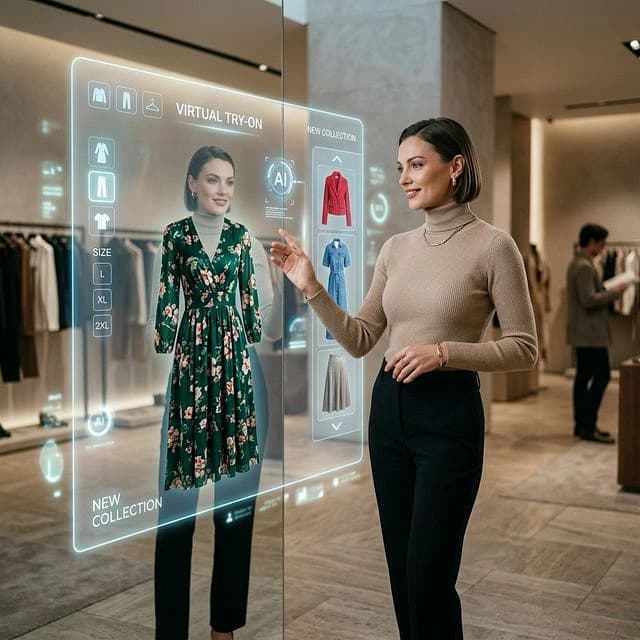
Online fashion shopping has transformed how people buy clothing.
Today, millions of shoppers browse ecommerce websites and social media platforms to purchase garments such as lehengas, dresses, sarees, and western outfits.
But one problem continues to affect online clothing sales.
Customers cannot try garments before purchasing them.
When shoppers visit a fashion website, they often wonder:
“Will this outfit look good on me?”
Because they cannot physically try the garment, many buyers hesitate to complete their purchase. Others order the product but return it later if the fit or appearance doesn’t match expectations.
According to ecommerce research published by Shopify, fashion products have one of the highest return rates among online retail categories.
This challenge has encouraged fashion brands and technology companies to explore AI garment try-on technology.
Instead of imagining how clothing might look, customers can now preview outfits digitally using artificial intelligence.
In this guide, we’ll explore the best AI tools for garment try-on in India, along with real-world examples showing how fashion companies are experimenting with this technology.
What Is AI Garment Try-On Technology?
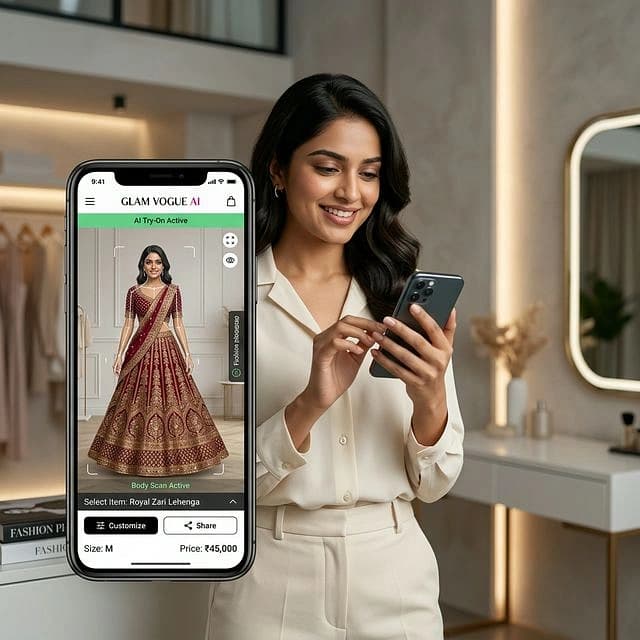
AI garment try-on technology allows shoppers to visualize clothing on a digital model or avatar.
Instead of static catalog images, customers can interact with garments digitally.
These systems combine multiple technologies, including computer vision, generative AI, and body mapping algorithms.
The software analyzes clothing images and overlays them onto digital body models that simulate human proportions.
Some advanced platforms even allow customers to upload their own photo or create a personalized avatar.
Because of these capabilities, AI garment try-on platforms are commonly referred to as virtual fitting rooms.
Why Virtual Try-On Technology Is Growing in Fashion Ecommerce
Fashion ecommerce is highly visual.
Customers rely heavily on images to understand how clothing looks when worn.
However, traditional catalog images only show garments on one model.
This makes it difficult for shoppers to understand how the garment will look on their own body type.
Virtual try-on technology addresses this issue.
It allows customers to explore clothing more interactively.
Fashion brands are adopting this technology for several key reasons:
- Improves Buyer Confidence: Helps shoppers visualize garments on their own body type.
- Reduces Product Returns: Minimizes sizing uncertainty and 'bracket ordering' (buying multiple sizes).
- Increases Engagement: Boosts time spent on site through interactive and immersive experiences.
- Differentiates Your Brand: Positions your store as a tech-forward leader in the Indian fashion market.
Industry experts believe AI will play a major role in shaping the future of fashion retail.
A report from McKinsey explains how generative AI is expected to influence fashion design, marketing, and digital retail experiences.
Best AI Tools for Garment Try-On in India
Below are several AI platforms that fashion brands and ecommerce retailers are exploring for virtual garment try-on.
Lalaland.ai
Lalaland.ai is an AI platform that generates digital fashion models for clothing brands.
Instead of organizing photoshoots with multiple models, brands can generate diverse AI models to display their garments.
This allows companies to create product images faster while showcasing clothing on different body types.
A real example of this technology being used in the fashion industry comes from Levi’s.
The denim brand partnered with Lalaland.ai to explore AI-generated fashion models for ecommerce imagery.
The collaboration was reported by The Verge.
Levi’s experimented with AI-generated models to increase diversity in product imagery while reducing the need for repeated photoshoots.
This example shows how AI visualization tools are beginning to influence fashion marketing strategies.
Zyler Virtual Try-On
Zyler is a virtual fitting room platform that allows shoppers to upload their photo and see how garments might look on their body.
Instead of viewing clothing on a generic model, customers can see the outfit applied to their own image.
This creates a more personalized shopping experience.
The technology has been discussed in retail innovation coverage.
For example, Retail Week reported how fashion brands use Zyler’s technology to improve customer engagement.
Virtual try-on platforms like Zyler help retailers create interactive shopping experiences that encourage customers to explore products more deeply.
Reactive Reality Virtual Dressing Room
Reactive Reality provides AI-powered virtual dressing room technology for ecommerce platforms.
The system uses 3D garment simulation to show how clothing fits different body shapes.
Fashion retailers can integrate the technology into their websites so customers can preview garments before purchasing.
This type of technology is particularly useful for brands that sell a wide range of clothing sizes.
Style.me Virtual Fitting Room
Style.me offers an AI-powered virtual fitting room that allows shoppers to try outfits on customizable digital avatars.
Customers can create an avatar based on their body measurements and preview different clothing styles.
This makes the shopping experience more immersive.
Several fashion ecommerce platforms are exploring similar avatar-based try-on systems.
Google’s AI Virtual Try-On Research
Large technology companies are also investing heavily in virtual try-on research.
Google has developed an AI-powered system that allows shoppers to see clothing displayed on models with different body shapes and skin tones.
Instead of relying on a single catalog model, users can explore how clothing appears on a variety of body types.
Google introduced this technology in its shopping platform experiments.
This development shows how major technology companies see virtual try-on as a key feature for future ecommerce experiences.
Realistic Example: How AI Try-On Can Help an Indian Boutique
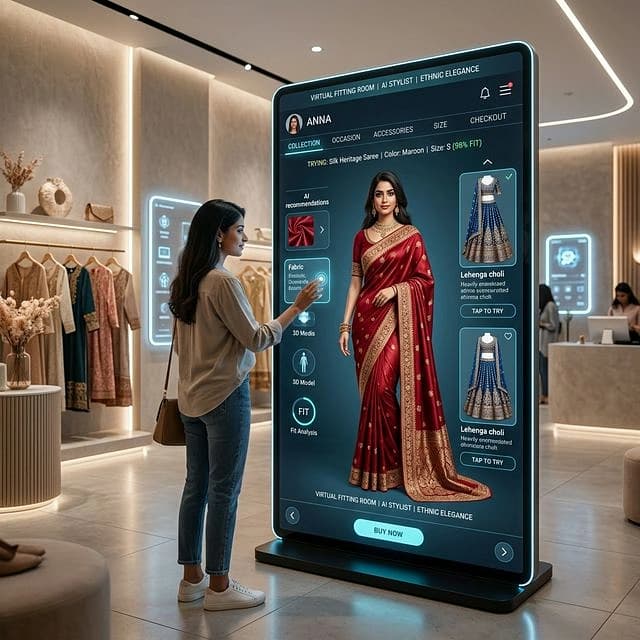
Imagine a boutique seller in Surat launching a new lehenga collection online.
Traditionally, the boutique would upload catalog photos showing the lehenga worn by a single model.
Customers browsing the website might like the design but still hesitate to buy because they cannot visualize how the outfit would look on them.
With AI try-on technology integrated into the store, shoppers could preview the lehenga on digital models with different body types.
Some systems would even allow customers to upload their photo to see how the lehenga might appear when worn.
This interactive experience helps shoppers feel more confident about their purchase.
For the boutique owner, the result could be higher customer engagement and fewer product returns.
Future of AI Garment Try-On in India
India’s online fashion market continues to grow rapidly.
As more consumers shop for clothing online, technologies that improve digital shopping experiences will become increasingly valuable.
Virtual try-on technology is expected to evolve in several ways.
Future systems may allow customers to generate highly accurate personal avatars based on body measurements.
Garment simulations may replicate fabric movement and draping more realistically.
Shoppers may even be able to mix and match entire outfits digitally before making a purchase.
As these technologies mature, virtual try-on could become a standard feature across fashion ecommerce websites.
For Indian fashion brands, early adoption could provide a strong competitive advantage.
Key Takeaways for Indian Fashion Brands
- Visualization is Essential: Digital fitting bridges the gap between static photos and real-world trials for online shoppers.
- AI Boosts Certainty: Accurate simulations and overlays give customers the confidence to complete high-value purchases like lehengas and sarees.
- Early Adoption Advantage: Getting ahead with virtual try-on software provides a major competitive edge in India's rapidly growing ecommerce market.
- Scalable Growth: Use AI platforms like Lalaland.ai and Zyler to manage thousands of SKUs without increasing traditional photoshoot costs.
For clothing brands looking to improve online shopping experiences, AI-powered virtual try-on offers a powerful way to bridge the gap between digital browsing and real-world fitting rooms.