How AI Can Significantly Reduce Product Returns in Fashion E-Commerce

Product returns are one of the most expensive challenges in fashion ecommerce.
Unlike electronics or household products, clothing purchases involve uncertainty. Customers cannot physically try on garments before buying them online. Because of this limitation, many shoppers order multiple sizes or styles and return the ones that do not fit or match their expectations.
Industry reports show that fashion ecommerce return rates can reach 30–40%, making returns a major operational cost for online retailers. Handling returns involves multiple steps including reverse logistics, product inspection, repackaging, and inventory updates, all of which increase operational costs and reduce profitability.
This is where artificial intelligence is transforming online fashion retail. AI-powered tools help retailers predict which products will fit customers best, recommend the correct size, personalize product suggestions, and simulate how garments will look when worn.
The result is simple but powerful: customers make better purchase decisions, which significantly reduces return rates. In this comprehensive guide, we will explore how AI helps fashion ecommerce companies reduce product returns, supported by real-world examples and industry insights.
Why Product Returns Are So High in Fashion Ecommerce
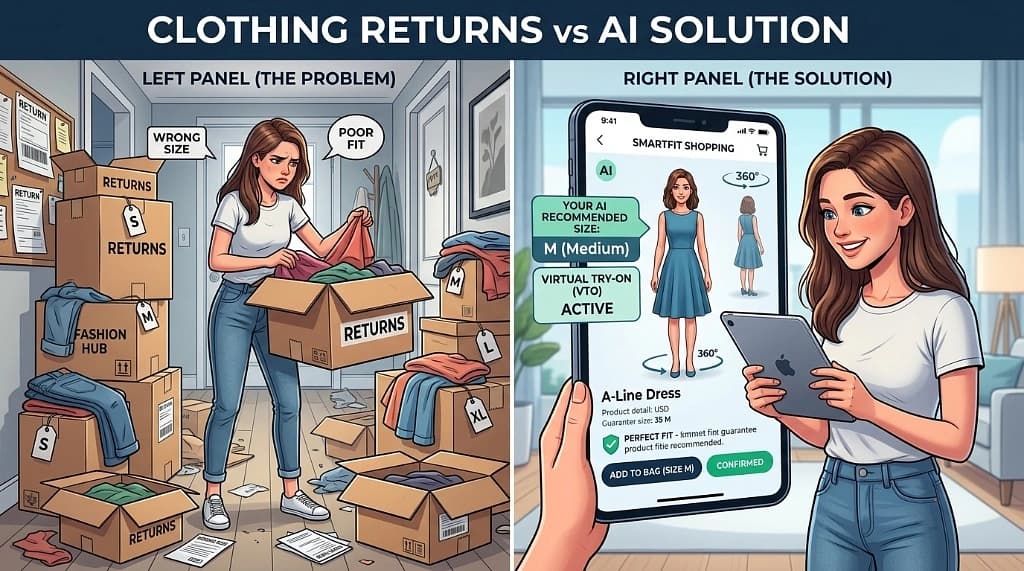
Before exploring how AI solves the problem, it is important to understand why clothing returns happen so frequently in online retail.
Inconsistent Sizing Standards
Unlike many other industries, clothing sizes are not globally standardized. A medium-sized shirt from one brand may fit differently compared to a medium size from another brand. Customers often rely on guesswork when choosing their size, leading to incorrect purchases and returns.
Lack of Physical Product Experience
In physical stores, customers can try garments before purchasing. Online shopping removes this ability. Even with detailed product photos and descriptions, customers may struggle to visualize how a garment fits their body type or how the fabric drapes.
Multiple Size Ordering
Many online shoppers intentionally purchase multiple sizes of the same item, keep the best-fitting option, and return the rest. While convenient for shoppers, this behavior significantly increases operational costs for retailers.
How Artificial Intelligence Is Changing Fashion Ecommerce
AI allows ecommerce platforms to analyze massive datasets and identify patterns in customer behavior. Machine learning systems can process previous purchases, customer measurements, browsing behavior, return history, and product reviews to predict which clothing items are most likely to fit a customer.
This predictive capability allows retailers to guide customers toward better purchase decisions, reducing the number of returned products.
AI Technologies That Help Reduce Fashion Ecommerce Returns

AI Size Recommendation Systems
AI sizing tools analyze customer data and historical purchase behavior to recommend the most accurate clothing size. These systems learn from large datasets of customer orders and returns to improve size accuracy over time.
Virtual Try-On Technology
Virtual try-on technology allows customers to digitally preview how clothing items may appear on their body. Some platforms use avatars based on body measurements, while others simulate clothing on different body shapes, reducing uncertainty and increasing purchase confidence.
AI Personalization Engines
AI recommendation systems analyze customer preferences and suggest clothing items that match their style and purchase history. When customers buy items aligned with their tastes and needs, they are less likely to return them.
Real Examples of AI Reducing Fashion Ecommerce Returns
Zalando: Fitting Prediction Accuracy
European fashion platform Zalando uses machine learning algorithms to predict which clothing sizes are most likely to fit customers correctly. Their AI systems analyze purchase and return data across millions of customers to reduce size-related returns.
ASOS: 'See My Fit' Tool
Online fashion retailer ASOS introduced a feature called 'See My Fit.' This technology allows customers to view clothing items on models with different body types, helping them visualize fit more accurately.
Amazon: Machine Learning for Size Recommendations
Amazon has developed machine learning systems designed to recommend clothing sizes based on previous purchases and customer feedback. These algorithms predict which size a customer is most likely to keep.
True Fit AI Platform
True Fit is an AI-powered platform used by many apparel brands to recommend accurate clothing sizes. The platform analyzes data from millions of shoppers to predict fit across different body types.
Business Benefits of Reducing Product Returns
Reducing returns offers lower logistics costs, faster inventory turnover, higher customer satisfaction, and improved profit margins. Satisfied customers who receive items that fit correctly are more likely to stay loyal to a brand.
The Future of AI in Fashion Ecommerce
Future innovations like personalized virtual fitting rooms and AI-generated body measurement tools will further improve purchase accuracy and reduce returns.
Key Takeaways
AI provides powerful tools to address the return problem through size recommendation, virtual try-on, and personalization, helping ecommerce businesses thrive in a competitive market.